
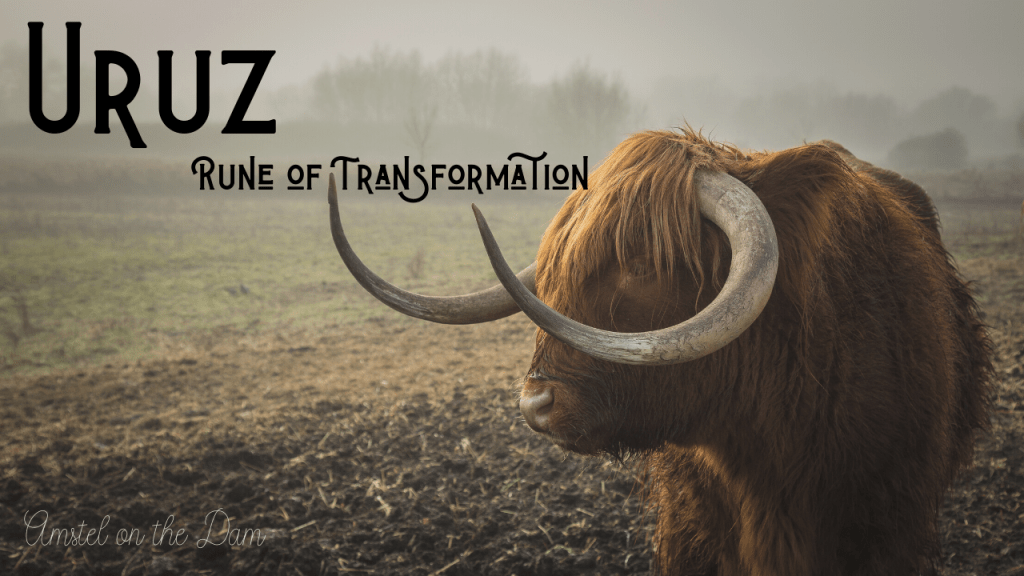
Wow. Where do we start? There’s a lot to unpack here guys. So, grab a seat, get some coffee and get comfortable because we’re in for a wild ride!
Linguistics and History
First let’s start with what the letter in question: Uruz. As with everything runic in study we must first start with the linguistics. Once again, we’ll turn to trusty Wikipedia for our source of the etymology.
“…The word urus (/ˈjʊərəs/; plural uri) is a Latin word, but was borrowed into Latin from Germanic (cf. Old English/Old High German ūr, Old Norse úr). In German, OHG ūr was compounded with ohso “ox”, giving ūrohso, which became early modern Aurochs. The modern form is Auerochse.
The word aurochs was borrowed from early modern German, replacing archaic urochs, also from an earlier form of German. The word is invariable in number in English, though sometimes a back-formed singular auroch and/or innovated plural aurochses occur…It is directly parallel to the German plural Ochsen (singular Ochse) and recreates by analogy the same distinction as English ox (singular) and oxen (plural).” (Aurochs, 2019)
Next we’ll turn to the article for Ur(Rune) for a tad more insight,
“The Icelandic word for “rain” and the Old English for “aurochs” go back to two different Proto-Germanic words, *ūruz and *ūrą (although possibly from the same root) The Norwegian meaning “dross, slag” is more obscure, but may be an Iron Age technical term derived from the word for water” (Ur(rune), 2018)
The case can be made for both meanings. Since modern Rune reading is really a comparative study of not only three languages but also three different cultures. (Across how much time?) But since Laguz translates to lake or leak and therefore water in its liquid state, I’m going with Aurochs.
Okay then, what the hell was an Aurochs?
An Aurochs was the wild ancestor of the domesticated cow. Therefore, Aurochs is to Cow as Wolf is to Dog. (At this point if you haven’t read my post on Fehu, I’m going to suggest you do so ‘here’, I go into detail about the domestication of cattle and it’s pertinent to understanding Uruz so please take the time to at least skim it). Cattle were amongst the first animals to be domesticated by man and unlike our other domesticated animal partners their wild counterparts went extinct in the 1600’s when the last one died in Poland of natural causes (Aurochs, 2019)
Now, 400 years later, we are desperately trying to recreate or ‘re-wild’ the domestic cow by a process called ‘back breeding’. This process utilizes genetic information salvaged and mapped from viable fossils, then compared to modern specimens with compatible genetic traits. The ultimate goal being to reconstruct an extinct species. Not a ‘new’ breed of cow. It was presented by the Heck Brothers in the 1920’s that ‘A species is not extinct as long as all its genes are still present in a living population’ (Aurochs, 2019) Wait, what?
Apparently, the Aurochs played such an important role in the ecology of Europe that its absence is beginning to have a detrimental effect to the point that humanity is going to great lengths to literally reanimate an extinct species. So important is its role in the environment.
That’s right ladies and gentlemen. The Domestic Cow is the first animal that humans are actively trying to ‘re-wild’. First, we tamed it, then we killed it, now we are re-wilding it. (You can check the Wikipedia article for it here btw. There are several programs going on at once, one of which is called, you guessed it the Uruz Project) Just to clarify here, this is not the same thing as cloning a mammoth from a fossil. This is taking genetic information from modern living cows and breeding them to get the right animal.
There is literally too much information on this animal I want to talk about and I simply do not have the time or space. I could give a whole class on this rune alone and one day I probably will. But for now, I’ll have to give you the crash course and hope to hell it makes sense.
I’d be remiss if I did not at least mention the level of universal importance cattle, wild and domestic, had to humanity. Almost since the beginning of time it appears humans have revered and worshiped our bovine friends. Important enough to prehistoric man to be included in the Lascaux paintings and exalted in every single culture they appeared. From North America to far East Asia; including our own Ancient Norse societies.
We find them in our lore such as Audhumla who sustained the giant Yimir and licked Buri from the ice, and in the first two letters of the Elder Futhark. There is no doubt about it, cattle, wild and domestic, were sacred to our ancient ancestors; far more than we tend to give them credit for.
Julius Caesar wrote about these animals in his Gallic War Commentaries:
“…those animals which are called uri. These are a little below the elephant in size, and of the appearance, colour, and shape of a bull. Their strength and speed are extraordinary; they spare neither man nor wild beast which they have espied. These the Germans take with much pains in pits and kill them. The young men harden themselves with this exercise, and practice themselves in this sort of hunting, and those who have slain the greatest number of them, having produced the horns in public, to serve as evidence, receive great praise. But not even when taken very young can they be rendered familiar to men and tamed. The size, shape, and appearance of their horns differ much from the horns of our oxen. These they anxiously seek after, and bind at the tips with silver, and use as cups at their most sumptuous entertainments.” (Aurochs, 2019)
I can only imagine a bull slightly smaller than the size of an elephant. However, we are in luck as we do have an extensive fossil record. “..during the Holocene, aurochs from Denmark and Germany had an average height at the shoulders of 155–180 cm (61–71 in) in bulls and 135–155 cm (53–61 in) in cows” (Aurochs, 2019). The Romans would also capture these animals and use them for their games in the arenas. Just in case the size and ferocity escaped your attention, the Romans thought them excellent stock to fight for sport.
As the Aurochs became rarer, so did the privilege of hunting them. Thus, the hunting of one and manufacture of drinking horns became a symbol synonymous with high social status. Eventually, hunting became restricted as a right only enjoyed by royalty until eventually it was off limits all together and the punishment for poaching and aurochs was death. The last one finally died in 1627.
Nonetheless, they live on in modern iconography as symbols of nobility and strength. Interestingly enough, Mecklenburg, Germany, where Mecklenburg County takes its name, sports an Aurochs in its coat of arms. As a Carolina girl, I find that fascinating.
The Runic Poems
So now that we have an understanding of the linguistics and the history surrounding the animal let’s turn our attention to the poems.
The Anglo Saxon
The ox is single-minded and over-horned,
most savage beast, fighting with his horns,
well-known moor-stepper. That is a proud creature. (Hostetter, 2019)
The Old Norse Poem
Dross comes from bad iron;
the reindeer often races over the frozen snow.
The Old Icelandic Poem
Lamentation of the clouds
and ruin of the hay-harvest
and abomination of the shepherd. (Halvorsen, 2019)
At first glance these poems have absolutely nothing in common. I’ll also tell you now that as we further our exploration into these poems this won’t be the last time we’ll see such strong deviancy. My preferred strategy when it comes to analyzing poems that seemingly have nothing in common is to find themes. Themes in the animal, and themes in the content.
If there is one common theme all three of these poems have, and one thing we have learned about our dear friend the Aurochs: it’s transformation.
First think about the animal. We actively engineered the Aurochs through a method of selective breeding which transformed it into the domestic cow, a new animal. A combination of factors—mostly man-made—forced it to extinction. Its absence created a devastating impact to Europe’s environment, so dire, humanity is genetically engineering from modern domestic cows its wild ancestor. If this is not transformation. I don’t know what is.
Further, in the Norse Poem, ‘Dross come from bad iron’. Is really describing the smelting process of iron ore. The changing of a literal rock into a usable metal. A process commonly thought of as magic in its day, to say nothing of the sanctity of iron. To say nothing of the implications of purification. Again, a transformation process. Solid to liquid.
‘The reindeer often races over the frozen snow’
The mere act of water freezing in and of itself is transformative—look deeper. Water and snow freeze so hard in the regions where reindeer are found, rivers become solid. Land features that would be otherwise uncrossable for parts of the year, becomes crossable. Liquid to solid.
Changing gears, refer back to the Icelandic Poem. ‘Lamentation of the clouds’ That’s obviously rain. The Ancient Norse perhaps had no way of knowing that clouds were water in a gaseous state, we do. Now we have an example of gas into liquid, another transformation process. You’ll recall the water cycle is just water transforming from one state of matter to the next. Ergo, water down to its chemical nature, is transformative.
‘and ruin of the hay-harvest’ This isn’t just a description of bad weather destroying your crops, this is a description of bad weather destroying your *harvest*. Hay, or grain, has to be dried before it can be stored. It’s probably the one time you *don’t* want rain as a farmer. And the most vulnerable time in grain cultivation. Rain has the power to transform one’s crop into waste, and from there death. (And we’ll ignore the transformative properties of death for the sake of brevity)
The last line, ‘and abomination of the shepherd’ has got me. I would think that predators or thieves would be the highest threat to shepherds but floods and destructive rain are probably more common and more unpredictable. Predators and thieves can be dealt with easily and the damage minimized; bad weather can destroy your whole flock and kill you in the process. Whatever form the threat may take, the result is still the same— labor transformed to waste.
Interpretation and Use in Magic
Pick up almost any book on rune reading (and I do mean any, I probably have a copy of every popular secondary source since I started writing this article) and most any author will tell you ‘primal creative energy’. Transformation is roughly in the same vein I feel. They’ll also add in strength, masculinity (massive eyeroll) and destruction.
None of these are wrong. (Except the masculine aspect, because both males and females have horns and I will die on that hill.) What makes Uruz unique though isn’t that it’s a transformative power, or that it’s a primordial creative energy. It is a transformative power, that if we stand to the task, we can control and use to shape our destines and the world around us.
Uruz can signify a challenge, and an obstacle, but never a blockage; that would be Isa. We can use Uruz to draw strength. Not just strength but also courage and bravery. Two aspects of strength I think are of underrated.
Either you can take an active role in transforming your life when this rune comes up in a spread, or you can take the passive role and allow your circumstances to control you. In other words, are you going to take life by the horns? Or are you going to allow yourself to get trampled? We are the masters of our own destines and Uruz is here to remind ourselves of own power and agency. Where there is a will, there is a way.
In magic Uruz is a great rune for clearing away obstacles. There’s nothing left of anything after a stampede of bulls (how’s that working for you Chicago?). It is an offensive rune and should you find yourself in need to protect yourself, call upon Uruz responsibly. Often times in life we find ourselves drained of energy and mettle, Uruz can be used to replenish our personal stores.
It is also an incredible rune to call upon at the beginning of a new journey or phase in life. After all its primary energy is transformative, why not harness that energy to your own benefit? Such as the start of a new job, the beginning of a new school year, or any other event of transition. Maybe a new marriage or graduating high school or college? Start of a Saturn Return anyone?
Because of its association with iron, Uruz could be used for purification. I have not tried that but the poems do make the suggestion. It also makes references to fertility, so there is also that to consider.
*whew* That was a *lot* And I wasn’t expecting all that. Thanks for sticking with me. Because of all the information I threw out here, have a look at my bibliography. Maybe one day I’ll be less lazy and do Chicago formatting. But for now MLA is much simpler and allows me to flout plagiarism laws ;P
Bibliography
Aurochs. (2019, Ocotober 26). Retrieved from Wikipedia: https://en.wikipedia.org/wiki/Aurochs
Halvorsen, I. (2019, October 27). The Rune Poems. Retrieved from Runes: Alphabet of Mystery: http://www.sunnyway.com/runes/rune_poems.html?fbclid=IwAR1_ou2MY1SOtLRvTlNohQA1NnjpOxosXV_7nyH12tL9kaLeR9iL01i0sWQ
Hostetter, D. A. (2019, ocotber 26). The Rune Poem. Retrieved from Anglo Saxon Narrative Poetry Project: https://anglosaxonpoetry.camden.rutgers.edu/the-rune-poem/
Ur(rune). (2018, July 19). Retrieved from Wikipedia: https://en.wikipedia.org/wiki/Ur_(rune)

 Amstel On The Dam
Thank you so much for your input, I’m so sad to hear how climate change continues to influence the meaning of this rune
LikeLike