
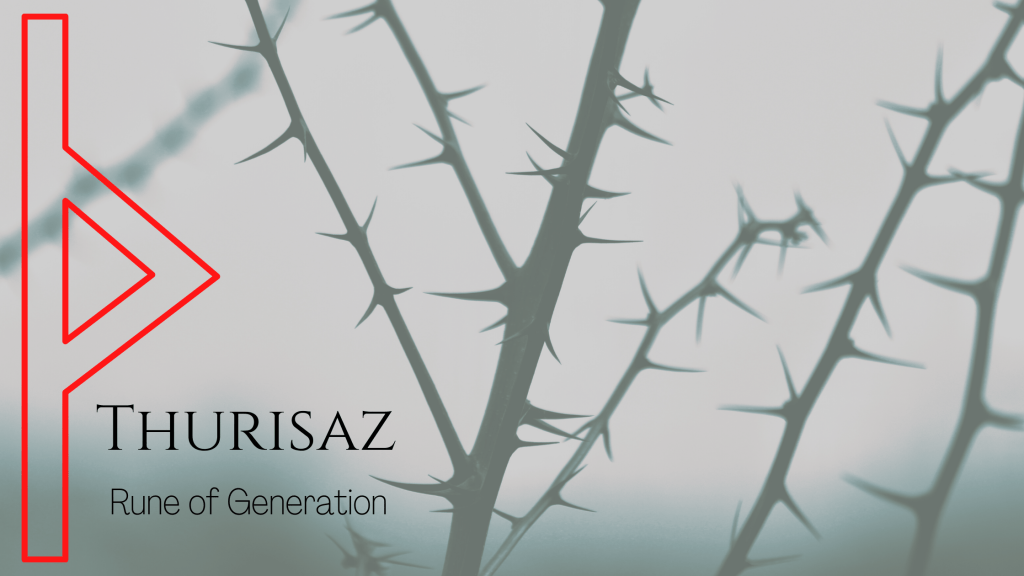
Thurisaz: Rune of Generation
Hey ya’ll! Welcome to installment 3 of my Modern Rune Study, (maybe I should call it Millennial Rune Study?) and this time I have uncovered more research and insights than I can shake a stick. So, let’s get to it shall we?
First, we’ll begin with the language, examine some mythology, read over the poems, and then we’ll make ritual sacrifices and throw ourselves down the well of wyrd! Because man has this been heck of a rabbit hole.
Before we begin though, CW/TW, viewer discretion advised, rape, sexual assault, and
Let’s pull up the Wikipedia page for the letter first. “The rune ᚦ is called Thurs (Old Norse Þurs “giant”, from a reconstructed Common Germanic *Þurisaz) in the Icelandic and Norwegian rune poems. In the Anglo-Saxon rune poem it is called thorn, whence the name of the letter þ derived. It is transliterated as þ, and has the sound value of a voiceless dental fricative /θ/ (the English sound of th as in thing).” (Thurisaz, 2018)
Giants, you say? Sounds like a good starting place to me! So what is a giant in Norse Mythology? I’ll refer to my favorite contemporary Norse Mythology Scholar, Daniel McCoy for his take: “The Giants of Pre-Christian mythology and religion of the Norse and other Germanic peoples are a tribe of spiritual beings whose power equals that of the two tries of gods, the Aesir and the Vanir. Their character, however, is very different from that of the gods—and, in fact, the giants and the gods correspond to opposing, but intertwined, cosmological principles.” (McCoy, n.d.)
McCoy also provides us with an interesting history with the etymology of how English came to call these beings, ‘giants’. “Giants is a misleading Anglicization of the name of these being. In modern English, if course, a “giant” is first and foremost something of enormous size…Speakers of Old Norse called them jotnar (singular jotunn, pronounced roughly “YO-tun”) or thursar (singular thurs, pronounced “THURS” like the first element in “Thursday” but with a soft “s” at the end). Jotunn comes from the Proto-Germanic *etunaz and means “devourer.” The Old English eóten is a cognate (it means the same thing and comes for the Proto-Germanic *thurisaz and means something like “powerful and injurious one” with a secondary connotation of “thorn-like.” The old English dyrs and Old High German duris are cognates… When the Norman (French) William the Conqueror seized control of England in 1066 CE, the English language became filled with French words. Among these loanwords was the Old French geant, the ancestor of the modern English word “giant,” which replaced the Old English eóten. Geant referred to the Giants of Greek Mythology, who were a Group of spiritual beings who, like the jötnar of Germanic mythology, were the enemies of the gods. The Greek ancestor of geant, in turen, was once used to translate a Hebrew word that denoted beings of enormous size in the bible, and over time this connotation of “giant” became the world’s dominate meaning.” (McCoy, n.d.)
At this point I’d do some more digging, but McCoy has been such a dear and done the heavy lifting for us so I’m rolling with it. (Also please check out his blog here, he is a fantastic scholar, and writer and warrants you checking out his site, grabbing a copy of his book)
Mythology, Giants, and Generation
Eventually, I’ll write up a full companion piece on Giants in world mythology, but for right now, I’ll settle for a crash course in these interesting facets of world consciousness.
To start with, just about every world mythology more or less has their own version of ‘giant’. Be it, Hindu, Native American, Egyptian, you name it, they probably have some type of race of giants within their cosmology. Because of the scope and breathed of the topic our focus must be limited. In particular, to the Hebrew and Greek connections, since the history of our word is connected to these languages as it was used to translate documents from one language to the other. Which is a good thing, because my personal favorites in world mythology happen to be the Norse and Greek pantheons.
Definitions of course evolve over history, expanding, narrowing, and even altering from its original meaning all together. This is part of what makes a language living versus dead. The history of the word giant and its connection to Hebrew and Greek mythology is where I’m drawing half of my personal understandings and theories surrounding the Rune Thurisaz. (Backwards engineering translations is not for the faint of heart). They are linked to almost every terrible force nature and natural source of chaos. They are revered, they are feared, and they are powerful.
In Norse mythology we see them as Yimir, Skadi, Loki and Mimir. In Greek Mythology they are known as Gaia, Uranus and Cronus. In Hebrew mythology they are known as the Nephilim, a race of human and divine being hybrids, largely unnamed. Theories suggest that Goliath was half Nephilim and half human, thus making him much larger than the average human but still much smaller than the aforementioned giants. However, Goliath is unique in that he’s the only individual specifically named in the Torah. To my knowledge. Hebrew mythology is intricate, to say the least, so if you know something, I don’t, shoot me an email or drop a comment. So much of Hebraic influences finds its way into modern Heathen and Neo Pagan practices, a basic understanding is helpful, if not necessary.
In Norse mythology, Mimir is a personal favorite of mine, but I’d wager the most prolific jotnär of all would have to be Ymir: the first being. In the Eddas, the creation myth varies wildly. Most versions can agree though that out of chaos Ymir came into being. Then came Audhumla, the primordial cow, who’s milk sustained Ymir, and who licked Buri, Odin’s grandfather, from ice. There are some gaps at this point, and details vary greatly, but the basic summary is: Buri, somehow, had a son, Bor, who a took a wife amongst the Jotnär, Bestla. With her he had three sons, Odin, Vili, and Ve. Together these brothers slew Ymir, and from his body fashioned the Nine Realms. The highlight of this story though, is that Odin and his brothers killed the first generation of life.
We can tie this to some interesting parallels found in Greek Mythology. Most interestingly, the congruencies the Jotnär have with the Greek Titans. (Which, strictly speaking are not the true giants in Greek mythology but ended up being labeled as such in Norse mythology due to a mistranslation, so here we are!) In Hesiod’s Theogony, Cronus, with the help of his mother Gaia, castrates Uranus. From his blood and severed appendage, creation springs. In the form of several entities, including Aphrodite rather than planes of existence.
Later, Zesus would come to overthrow his father, Cronus, and force him to regurgitate his other siblings that Cronus had devoured in his paranoia that his children would do to him as he had done to his father (Uranus). It’s a bit more complicated of course, being a Greek myth and all, but that’s the basic gist of it. The point is to see a theme of the younger generation overtaking the old.
Which brings us to Ragnarök. Aside from being the most ubiquitous of all the Norse myths, it’s not one I’d characterize as one being primarily about giants. However, it does have common themes of a younger generation over taking the old. And so, the young shall devour the old, or; from the old, a new world is fashioned.
This leaves us with the other meaning: Thorn.
Before we continue, I’d like to remind you, the reader, of a few key historic details to provide some much-needed context for the ASP later.
It is generally agreed the Anglo- Saxon Poem was originally written somewhere between the 8th and 9th centuries. By this time Christianity had already taken hold of the of the Anglo-Saxons approximately 100 years prior and runic script was on the decline. Also, important to note is the original transcript for this poem was preserved as part of the Cotton Manuscript and held in the Cotton Library which is now a collection of the British Library. In 1731, the Cotton Library caught fire and took with it several manuscripts of which the original transcript of the ASP was one. Therefore, all subsequent modern reprintings of the ASP are based off an altered version by George Hickes who heavily adulterated the original text. Thankfully though, he made annotations of where he made his changes. How’s that for the young over taking the old?
Dissecting the Poems
The Old Norse Poem
Thurs causes anguish to women
Misfortune makes few men cheerful
Nearly any book you pick up on runework will agree this rune has some AK undertones. Most will skirt the issue. Some will completely ignore it. I’ll call a spade a shovel. It’s AK.
It’s not uncommon for thorn to be a symbolic representation of a phallus. There are also other translations of the NRP that swap anguish for torture. The next time you have an appropriate opportunity, take a poll of close female confidants and ask them what their idea of supreme ‘torture’ would be. Chances are, rape is going to be the chief concern above even murder. It is also a crime that in antiquity, and in lesser developed countries, would affect men equally as it would women.
See, rape isn’t particularly insidious simply because it’s the most sadistic form of torture I can conceivably imagine. It’s insidious because not only does it continued to be employed as a weapon of war utilized to spread disease (HIV/AIDS anyone?); it is the only weapon to my knowledge that can conceive children.
As grisly as that consequence is to think about, name me a single man who would joyfully rear a child not of his own generation? Especially if the woman involved is his wife, daughter, sister or mother who so happened to be raped by enemy combatants? To reiterate here: ‘Misfortune makes few men cheerful.’ And to be to clear, we’re not discussing the active decision to adopt a child. We’re discussing the consequences to society of what happens when women are raped and forcibly impregnated as a result. (The UN calls that genocide btw)
What this passage is describing here isn’t just typical violence against women. It’s describing how targeted misogynist violence affects us all. This is no mere act of war. This is an act of genocide.
Before moving on, it is worth mentioning that some authors and some of my peers do believe the torture reference could perhaps refer to menstruation. It is a fact of human biology that severe discomfort and pain is fact of life for some people.
I’ll admit on the surface level I find this interpretation to be fairly sexist. Since that would be a way, I would expect a cisgendered man to interpret this passage. However, it is true, that some men do have periods. Transmen are men and completely valid. I have personally been working to deprogram my concept of gendered dichotomy. That being said, beyond recognizing the applicability of this interpretation to gender queerness and transgender identity. I have to admit, it’s beyond my scope of understanding but I do want to acknowledge this link. Though it would be a modern understanding, it is still valid in our world and even in the ancient world. (Loki is the poster child of gender fluid after all) So, have at it ya’ll. Queer witches exist.
The Icelandic Rune Poem
Giant- Torturer of Women
And cliff dweller
And Husband of a Giantess
Immediately, we see the first line is almost identical to the ONP. As is the case with these poems we find more cryptic lines per usual. The Cliff Dweller reference is enough to drive almost any modern English-speaking student mad. However, this time, I found a lucky break. I managed to stumble upon a PDF copy of a book published in 1915, Runic and Heroic Poems of the Teutonic People by Bruce Dickins. (it’s free and you need to download it here) buried in the foot notes were two wonderful gems. ‘Kletta bui…cliff-dweller, a common kenning for giant… Vardruna, a giantess in the Nafnajmlor.’ (Dickins, 1915)
While you’re there, flip to page 44 to the transcribed Icelandic.
The second to last line makes reference to Vardruna there, which is a name of a giantess, not the Icelandic word for Giantess. So, we can infer from the footnotes that line probably translates closer to Husband of Vardruna. Here’s the deal, I can’t track down who exactly Vardruna was, and the document that references her name to my knowledge, the Nafnajmlor, is an odd one.
It’s traditionally associated with Snorri Sturulsson’s Prose Edda and is the last document at the end of the stories. However, because of academic controversy due to its authorship, namely that Snorri did not author the Nafnajmlor, English editions of the Eddas tend to omit it altogether. (I’ll include an online edition of the document in my resources page for the curious.) Outside of academic hooey over who may or may not have actually wrote it, to my understanding it’s just a list of characters. However, it’s unique in that this manifest of names is the only surviving reference we have to Vardruna, outside the Icelandic Rune Poem. Other than that, we don’t know who she is.
Further, and this is where it gets interesting, in Dickin’s transcription of the Icelandic text left one line untranslated. Which means Saturn, is attributable to Thurisaz. Skip to the next stanza for Ansuz for a moment, that last line is to Jupiter.
Next to stanza 12, for Tyr, last line references Mars.
We’ll examine those lines in greater detail when we approach those individual runes. But for now, just know that Ansuz is directly associated to Odin, and Tyr is directly associated to well, Tyr.
To whom Vardruna is married to, much less who she was is anyone’s guess at this point. However, if the author associated Jupiter to Odin, and Mars to Tyr, then theoretically the associated deity to Saturn ought to be Odin’s father considering that in Roman mythology Saturn is Jupiter’s father. This line of logic splits off in two other possibilities. First, the mysterious deity is possibly Bor. Second if that deity is Bor then either Vardruna is another name for Bestla or is another wife of Bor, both instances are equally possible given the patterns of Norse Mythology. Remember, Bestla is a giant herself. This is especially interesting given the fact that ´Saturnus Þengill´ as far as I can tell translates to ´Thane of Saturn´.
The mystery continues though. Who was the Saturn equivalent in Norse mythology? Some theories have been presented as Ymir. Either way, the reference is interesting and it is one that begets more questions than it answers. I suppose this will just have to be one question lost to time.
The Anglo-Saxon Rune Poem
Thorns are severely sharp. To any Thane
seizing it is an evil, measurelessly cruel
to every man who comes to rest upon it
“Þorn, so in all AS. Runic alphabets and in most of the OHG. Derivatives (of.v.Grienberger, Ark. f. n. F. xv. p. Iff.) Þ was adopted into the AS .book-hand and persisted throughout the ME. period, the last trace of it surviving in the archaistic ye(for the). The Scandinavian alphabets, however, have Þurs (of .AS. Þyrs, a giant) ,and the Salzburg Codex Gothic thyth, which have no connection with each other or with AS. Þorn” (Dickins, 1915)
This is the only note Dickins makes for the ASP for the letter of Thurs. No further context into what the stanza was attempting to communicate other than to say, it’s a totally different word. Also, if I read that note correctly, and if I’ve learned anything about these languages, I’d wager it’s what we call a false cognate. That is, words that look the same in two languages but have totally different meanings.
The only real way I can fathom trying to understand the meaning of the ASP is to consider the historic context and region of the writing. Thorns have long been considered a euphemism for a phallus, or male fertility. For example, theories abound in discussion about the fairy tale Sleeping Beauty about the fertility aspects associated with thorns and pricking.
However, I find it interesting that Thane is used, and then the reference to ‘every man’ is also made. I have no proof of what I’m about to say next other than this is my own personal understanding of the society, culture and history of the Anglo Saxons of the 9th and 10th centuries.
Thane is an archaic English word that is no longer in widespread use outside the realms of fantasy media and academic historic research. It’s an interesting one because above it was the rank of Earl, and that word did survive. Immediately below it would be a Thane. English peerage as we understand it today, or hell Western peerage in general, wasn’t as fully developed then as it would become later. Ranks weren’t exactly formalized outside of royalty, and while I’m sure social ranks were just as nuanced then as they are now, you really only had a handful of titles. King, Earl (really Ealdorman, or Eorl) Thane, Carl, Knight.
Earls were the closest to the king and I like to think of them like the ‘senators’ of their day. Whereas a Thane would have gained their land and prestige by military merit. Think like high ranking military personnel, such as a general, or admiral, but also even colonels and lieutenants could be given the rank if their service and loyalty merited such recognition (like for a bronze star for example). Carls are your everyday freeman, who held their own lands outside of kingship but probably had little military protection, but were not associated with the land as property the way serfs were. Which brings us to knight, and while I would not dare call them a common foot solider, they would be your modern-day equivalent of say, a navy seal, army ranger, generic military officer that will see active duty on the field rather than a distant command.
Aside from the social nuances of how rank worked, one also must remember that in one’s own domain, Earl, Thane, Carl, or Knight, in the absence of the king the noble was the rule of law. Period. Your common man was going to have more fealty and more loyalty to their local lord than they ever were to their king. Or at the very least more of a vested interest if not personal loyalty. You might go your entire life never knowing what your monarchs looked like, but almost everyone had seen the face of their local lord at least once in their life.
Having understood that Thane is also a synonym of king, or lord, there is one other way thorn could have been symbolically viewed by the ancient Anglo Saxons. The crown of thorns. Arguably the most ubiquitous symbol in all of Christianity next to the cross. Nobles really liked to associate themselves with Christ in any way they possibly could back in the day. And I see no reason why they wouldn’t do it here.
The last line and a half though. ‘Measurelessly cruel to any man who comes to rest upon it.’ If the line before is referencing the crown of thorns, then that sure as hell has to be a clear reference to crucifixion. The Romans weren’t picky about who they nailed, or tied rather, to those crosses. I am hard pressed to think of any other form of execution as cruel and used as widespread as crucifixion.
All of this is a hunch of course. But considering how this was a society that prized piety, or at least the outward appearance of it, and the poem has all sorts of other Christian references to it. I can’t imagine the Passion, the chief Christian story (not Christmas you pagans ;p) would have escaped reference. Hell, even in my Southern Baptist upbringing, no Sunday service was complete without singing ‘Are You Washed in the Blood?’ (I wasn’t kidding ya’ll when I said Southern)
Pulling it all together
Each of these poems, as different as they are, do have common themes. Destruction of course, but also generation and by extension fertility.
First, let’s examine generation. In this context it’s not enough to just limit its definition to that of those individuals collectively born together within society. It’s also imperative to consider the alternative definition, creation or production. As in generate or genesis, which has the Latin stem Gen, which means origin.
While I consider myself an academically trained historian, I am by no means the definitive expert on human history. I’m not sure anyone could call themselves that. However, I would wager my theoretical first born, the majority of human history is a history of conflict. And any student of history, sociology, and psychology can probably vouch for me when I say that humans have a remarkable propensity for getting bent out of shape over progeny.
Whole wars have been waged over the minutia differences found in human existence. Entire societies and cultures have been destroyed over the concept. Arguably the chief way to achieve this means is to destroy their generation: genocide.
Rape has been employed as a weapon of war since time immemorial. Outside of systemic extermination, campaigns of ethnic cleansing and apartheid policies; it’s arguably the most primitive and effective means of destroying a people. Rape affects all layers of society and its impact is everlasting. To start with, the trauma of the victim is enough to drive some individuals to suicide and some cultures even expect this. Patriarchal and misogynist views of the female body would mean social and societal damage not only to the victim, but to the victim’s family and partner. Then there is the question of the children that would result from such acts. How would they be assimilated into society; how would society continue after such a war?
If rape isn’t being used to destroy a society, it’s being used to preserve a society. How many women were traded off to men without thought to their desires in the interest of political alliances? And how many of those ‘husbands’ and fathers coerced those women into sex? All for the sake that men have their heir?
Generational trauma is on the cutting edge of medical science, and we know that it would be handed down to the offspring. I can’t imagine any of us having a line free from such trauma.
There is no escaping though this rune is heavily associated with the Jotun of Norse Mythology. Rather than reading them as another race or species entirely, it might be interesting to read them as a previous generation of the gods. After all, Bestla, Odin’s mother is a Jotun. As is Loki and Yimir. In fact, pull up a genealogy of the Norse pantheon. It makes more sense to me to see them as older, primordial beings than an entirely separate species as we often times think.
Even Ragnarök ends with the old gods dying and a new generation to take their place. You also see the same theme of intergenerational warring in other mythologies as mentioned earlier. Especially in Greek mythology and again in Hebrew mythology (check out the book of Enoch).
Even if the Anglo-Saxon Poem is a reference to The Passion, that would still be a story of generation. A god sacrificing his own son for the betterment of future generations. It’s flipped, the old sacrificing themselves to themselves, but you get the drift. Or if you take a more historical approach, Christ was murdered by the Sanhedrin council, themselves made up of elders from within Jewish society. Through Christ’s death arose Christianity, at first a sub cult of Judaism then eventually became its own separate religion. That in and of itself is literally the younger generation, Jesus, destroying the older generation, Judaism. Or so the Catholic church would have you believe. Nonetheless, the theme is found again.
Modern Usage
I don’t believe Thurisaz is inherently evil as some authors would have you believe *glares at Aswynn*. I like what Diana Paxson had to say best “Like nuclear power it can be used to heal or destroy.” (Paxson, 2005) (ironically though, even in medicine radiation therapy tends to be fairly destructive.) However, the ancients obviously had something serious to say when all three societies honed in on its destructive power. Why is it they choose to portray procreation as an act of torture and destruction rather than as pleasure and creation? And why did the Anglo-Saxons choose to highlight the burdensome, sacrificial qualities of leadership, rather than romanticize it as we so often do these days?
I think these passages were meant as a warning. While procreation miraculous as it is, has with it, its own set of dangers and destruction. A tool, of any kind, can be exceptionally dangerous if misused. However, employed correctly, knives, fire and even nuclear energy have been used for the greater benefit of mankind. We must not lose respect for the power of creation.
Moreover, it exposes an interesting truth to the human condition, the young and the old will forever struggle to find harmony. Some places in history will find the generations living more harmoniously than others. Others yet, may require total annihilation of one or the other, so that all may live and prosper.
I can think of no greater example of intergenerational conflict than the feud between Baby Boomers and Millennials. In and of itself a fascinating dynamic. Much of it is fueled by struggle of power dynamics. Many parallels can be drawn between Zeus being required to destroy Chronos in order to take his place and the plight of Millennials not having the same resources as their grandparents, and parents had.
Incredibly ironic though, is that it was the boomers who protested the Vietnam War, organized the civil rights movement and strong armed the American government into lowering the voting age to 18. Just a small smattering of some of their achievements. The flipside though is it is those very same cohorts who now refuse to relinquish their power to the younger generations, and continue to perpetuate antiquated ideas of prejudice. (Consider how many boomers still hold political office that are covertly racist and misogynist?).
Nature occurs in cycles, and demands balance. Our mythologies are filled with stories of what happens when the old hold on to their power past their prime. Our history is also filled with instances of when the youth is adulterated, and corrupted by the old, to carry out their agendas (Hitler Youth anyone?).
Magical Properties
Thurisaz is definitely the rune to call upon for help with fertility. A close mentor of mine has a story where he had a close friend who was trying to conceive. From what I understand, he laid a hammer in her lap, intoned the rune of Thurisaz and low and behold after years of trying to conceive the couple finally managed to do so.
Thurisaz is often times associated with the hammer, possibly because it both looks like one and is the first letter of Thor’s name. The hammer is an interesting association because unlike a sword, or a pike it’s one of the few weapons that can be used for both creation and destruction. In other words, you’re not about to use a sword to cut lumber for your house and then turn to the battlefield. A hammer on the other hand can be used to make repairs, and in self defense at a moment’s notice. It’s a level of duality rarely found elsewhere. Likewise, the thorn is employed as defense but can be to the right animal an attractant. Same also with the phallus. It can be used for pleasure or torture, grisly as that is.
It’s also a powerful rune of destruction and can be employed in such a fashion if the need were to arise. Not in the general clearing of obstacles sense that is Uruz, but in the sense of total annihilation you messed with the wrong witch sort of way. I’m not anyone’s parent; if you do use it offensively, make sure you’re justified in doing so.
Otherwise Thruisaz is perfect for defensive work. Use it in ways you would employ the use of a thorn. Perfect for use in wards, particularly house wards across thresholds and doorways, like stepping into a bramble patch. Use it in witch’s bottles, and other places in need of defensive barriers.
As always, I welcome feedback! How do you use Thurisaz in your personal practice? Any personal experiences you’d like to share? Drop a comment so we all may learn!

 Amstel On The Dam
One thought on “Thurisaz: Rune of Generation”